The Pitt Episode 3: Diving into The Pitt's 'Implicit Bias
Summary:
Blue Collar Allegations and Repercussions.
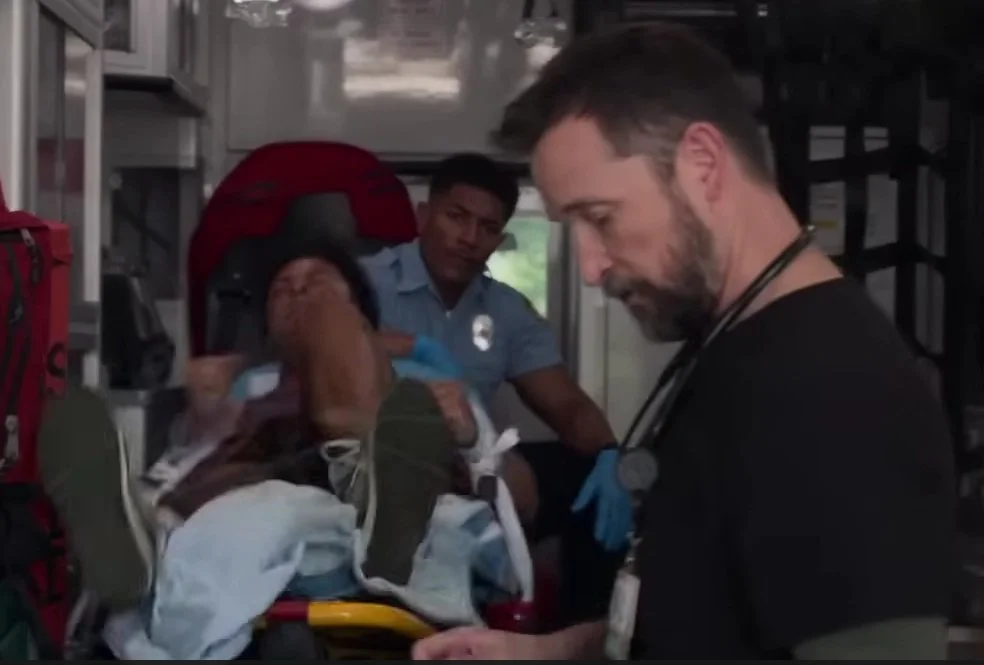
Meet Jackson Davis
A young man tased by a white security guard inside the campus library
"Get out! 2710," a young black man, Jackson Davis, screams as he's being wheeled into the ER. Paramedics, doctors and nurses struggle to restrain him long enough to get a reading of his vitals. His shouts fade in the background as the Department churns through patients. The chaos, par for the course in the minute-by-minute turmoil of the Pittsburgh Trauma Center.
Earlier that day Tony Chinchiolo, a white security guard, tased the frantic Jackson for being disorderly in the campus library. Behavior he believed to be fueled by a drug induced psychotic episode. An accusation marred by his own racist remarks when he used the term, "fucking animal," to describe the restrained victim. Allegations that would later be debunked by a clean drug screen. The security guard now finds himself on the opposite side of righteousness as the police have a few more questions for him.
White Collar Privilege
Just down the hall Trinity Santos, treats a young girl brought in for a chin laceration. The resulting examination revealed bruising across her young body. Trinity speaks with Dyllan, the hospital social worker. Her jaw is clenched, voice pitched, she feigns interest in a chart. Leaning into her suspicions, she presses Dyllan to view Kylie's father with the same skepticism. This assumption of guilt is in stark contrast to the calm professionalism around her. She needs Kylie's dad to explain how the bruising got there. With each passing minute he fails to show her suspicions grow.
When Kylie's father, Benny, does show up he is assailed by a barrage of questions and innuendo. Trinity and Dyllan press hard searching for answers that align with their preconceptions. A battering met with equal force by Benny. A heated exchange brought to a simmer only by a finding in Kylies' immune system. She suffers from ITP. A condition where her blood platelets are lowered causing severe bruising. Unlike Tony's judgement, however, Trinity suffers no repercussions. For Benny the unsubstantiated accusations reverberate throughout the episode as his personal life is now in turmoil.
Free to Cause Harm
The theme of resonance extends beyond this episode. Dr. Robby treats Yana Kovalenko, an elderly woman who dropped a hot samovar on her lap when fireworks exploded outside her house. The resulting accident wasn't just a simple fumble but stemmed from something far more sinister. Yana was at the Tree of Life Synagogue during the 2018 shooting. For her, Independence Day isn't a celebration of freedom but a painful reminder of how the abuse of those freedoms can bring tragedy.
A Capitalist Work Ethic Questioned
While Yana copes with trauma from her past, Mark and Nancy Yee grapple with the strain of potential loss. Involved in a motorcycle versus auto collision, Mark is suddenly unable to move. Nancy, absorbed with her husband's injuries, ignores her own, to the point of collapse. The couple had been arguing prior to the accident. Mark prioritized his work over family, spurring disagreement. The accident has forced Mark to reconsider his values and question his choices.
Just Getting Started
In addition to the big-ticket stories above, viewers are treated to a patient with dangerously low blood pressure—a condition triggered by a pill smorgasbord after he chose the wrong medication. Langdon removes beads from a child’s nose using a newfound bedside manner. And in a sign that the show’s momentum is just getting started, Pittsburgh Trauma prepares to take on patients from another hospital as they enter a code black.
For the gorehounds, the motorcyclist involved in the collision with Mark and Nancy Yee was riding without a helmet. He perished in the accident, a tragedy that delivers another behind-the-scenes look at trauma medicine, a staple the special-effects team is known for week after week.
The show’s stories are layered with meaning, and this week’s analysis will focus on the implicit bias featured prominently through Tony Chinchiolo and Trinity Santos.
Analysis:
Rich Man Poor Man Blinded Just the Same
The show pushes boundaries and isn’t afraid to run contrary to popular opinion. Consider Trinity and Tony Chinchiolo. Both use implicit bias while doing their jobs, yet only one suffers real consequences. Tony’s arc immediately evokes the cultural memory of cases like Trayvon Martin, where a figure in a "security" role allows a hoodie and a "suspicious" look to justify aggressive, and fatal, intervention. Tony, at the conclusion of his story, is being questioned by the police and faces charges for tasing an innocent man. Trinity, on the other hand, turns a man's life inside out, and we see her smiling at a surprising outcome. Between the two comparative cases, we tend to side with Trinity. Why?
The answer lies within our own bias. We see doctors as healers, people with good intentions. While the security guard is often perceived as someone who is typically uneducated or lacking authority, the show isn't asking us to choose a side but presents bias as a cloud. An affliction targeting everyone equally, including an impartial viewer. If partiality is equal, then perhaps the show is suggesting recognition is the cure.
The TV show is confident enough in its convictions that it isn't afraid to point fingers—not at its characters and not at its audience. It continually pushes the envelope and, as long as it does, it's sure to have a strong following.
Review:
Al-Hashimi Stands Up, Yee Come to Jesus, and a Touch of Melodrama
Let's get this out of the way, this episode was better than two. I liked the Banter between Robby and Al-Hashimi. When she tells him he's free to see other people, she's not looking for commitment but cooperation. That moment radiated quiet confidence, cementing her as a real threat. She showed Robby she can play his game and rise to the occasion. Equals competing for the same goal is the stuff great dramas are made of. The come 'to Jesus moment for Mark Yee was equally poignant.
Mark Yee, "Is this how it works? You think things are important…that everything is so important and then you end up here and see."
Robby, "Yeah, that is how it works."
And it worked for me. To create an effective character epiphany in such a short time span is truly remarkable. What didn't work for me was Mark Yee's subsequent phone message to his wife, which felt a little overly dramatic. Taking the episode in its entirety, it slaps and slaps hard:
My Score: 4.75 out of 5