The Pitt Episode 4: Secret Personas, Sharp Scalpels, and a Power Shift You Didn’t See Coming
Summary:
The Westridge Wager: High Stakes in the ER
Ogilvie’s Error
Overconfidence leads to a rookie mistake
A black dry‑erase marker emits an occasional squeak as it drags across a whiteboard. A security guard in an immaculate white uniform sketches the brackets for the upcoming bet. The wager? How many patients would be diverted, what would trigger it, and how long Westbridge Hospital’s Code Black would last.
Robby bets on flooding: three hours, twenty patients diverted from the incapacitated hospital. A sly smile — and an “ok, ok” — slips from the bookie’s lips as he weighs Robby’s proposal.
Baran, spotting an opportunity to ingratiate herself with the staff, steals Robby’s thunder. She counters flooding, four hours, and thirty patients, a challenge that sparks a primal delight among the bettors. While Baran's handling of Robby is passive aggressive, and at times manipulative, her stance remains firm. This is especially true when her authority is challenged by other members of the staff.
Baran vs. Trinity: A Lesson in Accountability
When she corners Trinity Santos over her charting delinquency, Trinity tries to shrug her off. Baran explains that deficient charts leave gaps for the providers responsible for continuity of care, which in turn delays hospital billing. Trinity replies sarcastically, “Oh, I’d hate to delay billing.” A flicker of disbelief crosses Baran’s face before she regains her composure. She offers Trinity a smile as sharp as a knife’s edge before her expression hardens into a scowl. Baran gives Trinity until the end of the shift to comply — or repeat her second year of residency. The exchange leads to a distracted and distinctly uncharacteristic hour for Santos.
Medical Hubris: The Danger of the "Quick Fix"
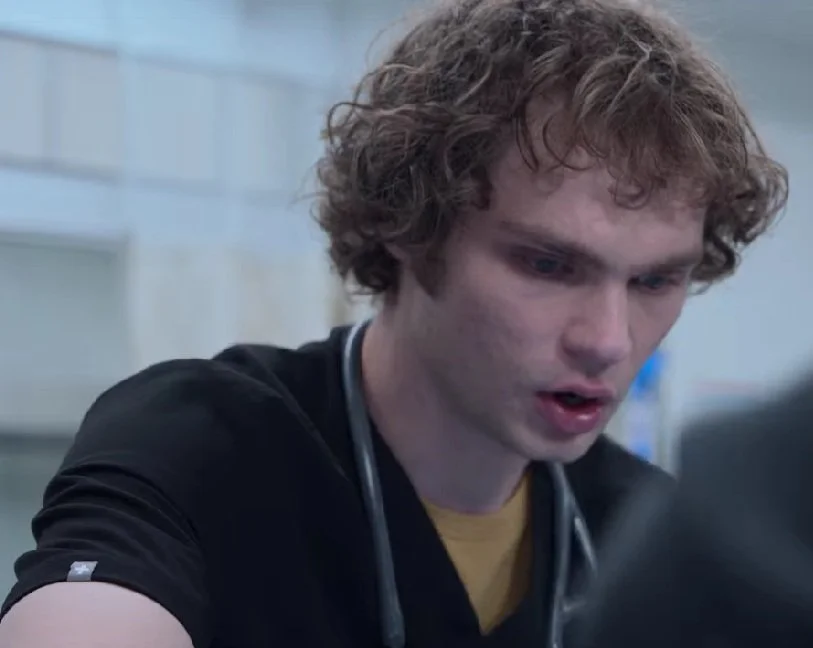
While Trinity is taking in her first bites of humble pie, another over-eager resident joins her. Vince Cole is brought into the ER after falling through a skylight while parkouring. The team believes they have him stable and glass-free when they notice blood pooling on the bedding. They place him on his stomach: a shard of glass lodged in his left flank. Ogilvie exclaims, "Yeah, a little piece of glass in there." He pulls it out before anyone can stop him. Big mistake. The glass was putting pressure on an artery preventing it from hemorrhaging. His arrogance turns into fear. Panicked, he hesitates, looking to the more senior staff for direction. They ignore him and move around his frozen frame, working to save Vince's life. This moment beautifully captures the second-by-second pressure the men and women are under in the emergency department. An environment that demands their full attention, not just in the moment, but to anticipate and be ready for the unexpected.
Missing the Signs: Trinity’s Costly Distractions
We see this hypervigilance all but evaporate from Trinity as she struggles with the possibility of repeating her second year of residency. Her lack of situational awareness leads to immediacy rather than in depth diagnoses in two situations.
The first occurs when Jean Samba, A fifty-four-year-old man, is admitted with left side chest pain. Trinity scans the EKG and ignores the subtle clues indicating a posterior heart attack. Instead of investigating further she orders another round of nitro and waits on more testing. Whitaker, on the other hand, draws on his experience and is more cautious. He orders a repeat EKG, this time placing the leads on the patient’s back. His suspicions are confirmed when the test reveals a massive blockage along the posterior wall of Samba’s heart. He's witnessing a heart attack in real time! Because of Whitaker's abundance of caution, he already had the lifesaving equipment in place. His preparation and persistence paid off.
Diagnosis: The Hidden Truths of Bulimia
Unfortunately, Trinity’s demeanor doesn’t improve. Phylicia Ronson is placed under Trinity’s and Mel’s care after Langdon refers her to the emergency department. She presents with flu‑like symptoms, but her tests return negative for viral infection. During their initial examination, Trinity is distant and disengaged. Mel must prompt her even to share what she heard through the stethoscope. The crackling Trinity noted in Phylicia’s right lung barely registers as a meaningful symptom. It is Mel who assembles the action plan and orders follow‑up X‑rays. The imaging reveals aspiration pneumonia, a condition caused by the patient’s bulimia. Trinity’s normally condescending attitude is notably absent in the face of real adversity.
The "Dr. J" Reveal: Javadi’s Secret Social Media Life
If this episode’s theme is all about stress, then Dr. “J” is our consolation. If you don’t know what I’m talking about, please watch this first: episode four (38:37). It turns out Javadi has a social media following, and Willow Baptiste, one of Javadi's followers, would like to be seen by her. After gluing her eyelashes shut, Langdon attempts to treat her but is always working in the shadow of “Dr. J.” It isn’t until Willow shows him a picture of the great doctor that he puts the puzzle together. He summons Victoria Javadi to ease his patient’s suffering. The star‑struck patient admits to watching all her videos. She found the one about coping with difficult coworkers especially helpful. Langdon’s reply—“I gotta watch that”—classic.
Analysis:
Power Plays and Disarmament: Baran’s Long Game
After this episode, if we weren’t already rethinking Baran’s character, it may be time we should. She has proven herself assertive, intelligent, and now, cunning. She possesses a clarity that Robby lacks. Westbridge Hospital’s crisis has become their own: they are understaffed and short on well‑rounded, qualified residents. Baran’s solution is simple, move Langdon from triage to the ER. Her obstacle is Robby. She understands that openly seizing power from him would be disastrous, a move that would only invite dissent. Instead, she outmaneuvers him to get what she wants.
When two more patients are wheeled in from Westbridge, Baran asks Robby if it’s time to bring Langdon back from triage. Robby pushes back, saying he wants Langdon to ease into it. Rather than conceding, Baran changes tactics. She asks about the wager and whether Robby is reconsidering his bet. He tries to shut her down again, claiming he’s still weighing his odds. Baran tells him not to worry—she’ll buy him a drink with her winnings. This isn’t an innocent flirtation; it’s a disarmament. Baran has been observing Robby and knows what he responds to. She’s getting him on her side. The next time she sees Langdon, she makes her move, transferring him from triage to the emergency department in full view of Robby. Robby says nothing. This power struggle is far from over, but Baran has drawn first blood.
The Real Cost of Care: Healthcare Inequality in The Pitt
From human drama to stories ripped from today’s headlines, the show challenges its viewers. When it’s revealed that Orlando Diaz was only taking half of his prescribed insulin, the natural question is why. He lost his insurance after the pandemic, and his current employer doesn’t offer medical benefits, so he self‑regulates. His situation, unfortunately, is not uncommon. Like many families, the Diaz's make too much money to qualify for Medicaid. Paradoxically, they live above the poverty line yet exist living paycheck to paycheck. Often, their best alternative is to purchase private insurance through the Affordable Care Act, a program that is constantly under attack. With few options, the burden of navigating these unforeseen expenses is left to the indebted alone. It’s now estimated that one in three crowdfunding campaigns exist to pay for medical expenses. A reality the show depicts with unsettling accuracy.
Review:
Final Verdict: Stress, Success, and Room for Growth
The show continues to excel with its human drama element. The events between Al-Hashimi and Robby are some of my favorites. They depict reality from my own workplace experiences, and it resonates. The revelation of Javadi's alter online persona was a standout moment. It felt so real, so awkward a trap of her own making, the stuff of great writing. My only complaint is that it didn't quite nail the bulimia segment. It focused tightly on Trinity, staying true to its theme, but I felt there was more to explore. It was compelling they pointed out that women of color are often under diagnosed for this horrible condition. It would have been more impactful to explore why, not just that, this disparity exists. Overall, another good episode that moves the needle forward.
My score: 4.25 out of 5.00